
The Molecular Interface
Why Sweat is a Solvent for Your Clothes
Bill Morris
3/2/20263 min read
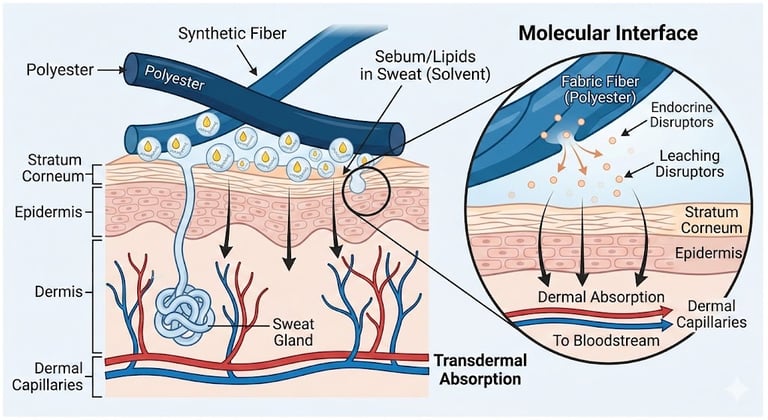
The Molecular Interface: Why Sweat is a Solvent for Your Clothes
As a materials scientist who has spent 15 years in the labs of biotech and textile firms, I’ve noticed a dangerous gap in how we talk about clothing safety. We treat fabric like a static, inert sheet—a barrier between us and the world.
But when you put on a pair of synthetic leggings or polyester underwear and head to the gym, that "barrier" becomes a dynamic chemical delivery system.
In my world, we have a saying: Like dissolves like. And when it comes to the plastic in your clothes, your body provides the perfect solvent: Sweat.
The Science: Sweat isn’t just Water
Most people assume sweat is 99% water and salt. But your skin also secretes lipids and oils.
Groundbreaking research from the University of Birmingham has fundamentally changed our understanding of dermal absorption. Their 2024 study provided the first experimental evidence that toxic additives—like flame retardants and plasticizers present in microplastics—leach into human sweat and are then absorbed through the skin into the bloodstream [1].
The researchers discovered that more hydrated or "sweatier" skin results in significantly higher bioavailability of these chemicals, with up to 8% of the chemical dose being taken up by the skin within 24 hours [1]. When you heat up and your pores open, you aren't just "detoxing." You are creating a high-transfer environment for toxins to move directly into your circulation.
The 'Recycled' Trap: A VP’s Perspective
During my time as a VP of Product, I saw the rise of "recycled polyester" (rPET). Marketing teams love it because it sounds sustainable. But as a scientist, I see a "chemical cocktail."
A December 2025 report by the Changing Markets Foundation revealed that recycled polyester is actually worse for your health and the environment than virgin polyester. Their lab tests found that recycled garments shed 55% more microplastic particles during washing because the fibers are more brittle [3].
More concerning for your health: these particles are nearly 20% smaller than virgin ones [3]. In materials science, smaller means more "bioavailable"—these tiny shards can penetrate deeper into your tissues and have even been detected in human reproductive fluids like follicular and seminal plasma [2].
The Hormone Threshold: Why 2026 is the Turning Point
The industry is finally starting to admit there is a problem. As of April 1, 2025, the global safety body OEKO-TEX® slashed the permitted limit of Bisphenol A (BPA) in textiles from 100 mg/kg down to just 10 mg/kg [4].
This 90% reduction was a direct response to toxicologists confirming that BPA—a known endocrine disruptor—is frequently found in textiles worn directly against the skin [4]. If your "performance" gear was manufactured before this change, it likely contains levels of BPA that are now considered unsafe by international standards.
The Vetted Takeaway
We shouldn't have to be materials scientists to know if our underwear is disrupting our hormones. But until the industry moves away from petroleum-based "performance" fabrics, we have to vote with our labels.
Next time you reach for those "moisture-wicking" leggings, ask yourself: Is the fabric wicking moisture away, or is my sweat pulling the plastic in?
Technical Source List


[1] Abafe et al. (2024). "Assessment of Human Dermal Absorption of Flame Retardant Additives in Microplastics." Environment International.





[2] Gomez-Sanchez et al. (2025). "Detection and Characterisation of Microplastics in Human Follicular and Seminal Fluids." Presented at ESHRE 2025.
[3] Changing Markets Foundation (2025). "Spinning Greenwash: How Recycled Polyester Worsens Microplastic Pollution."
[4] OEKO-TEX® (2025). "New Regulations 2025: Stricter BPA & PFAS Limits."
Contact
Reach out for questions or collaborations
© 2026. All rights reserved.