
The Hormone Audit:
Why Microplastics are Infiltrating our Reproductive Biology
Bill Morris
3/16/20263 min read
The Hormone Audit: Why Microplastics are Infiltrating our Reproductive Biology
By Bill Morris
In our previous deep-dives, we looked at how sweat acts as a solvent for textile chemicals and why recycled polyester is a molecular disaster. But the question I get most often as a materials scientist is: "Does it actually matter once it’s in my body?"
The clinical data from 2025 and 2026 has provided a definitive, and sobering, answer. We are no longer just talking about "exposure"; we are talking about bio-accumulation in our most sensitive reproductive systems.
The 2025 Breakthrough: Detection in Reproductive Fluids
For years, we speculated that microplastics could migrate from the skin and gut into systemic circulation. In July 2025, researchers at the ESHRE (European Society of Human Reproduction and Embryology) meeting confirmed this at the cellular level [2].
In a landmark study, microplastics were detected in 69% of human follicular fluid (the fluid surrounding a developing egg) and 55% of seminal plasma samples [2]. The most prevalent polymers found? PET (Polyester) and Nylon.
As someone who has designed medical-grade materials, I find this particularly alarming because reproductive fluids are supposed to be among the most protected environments in the human body.
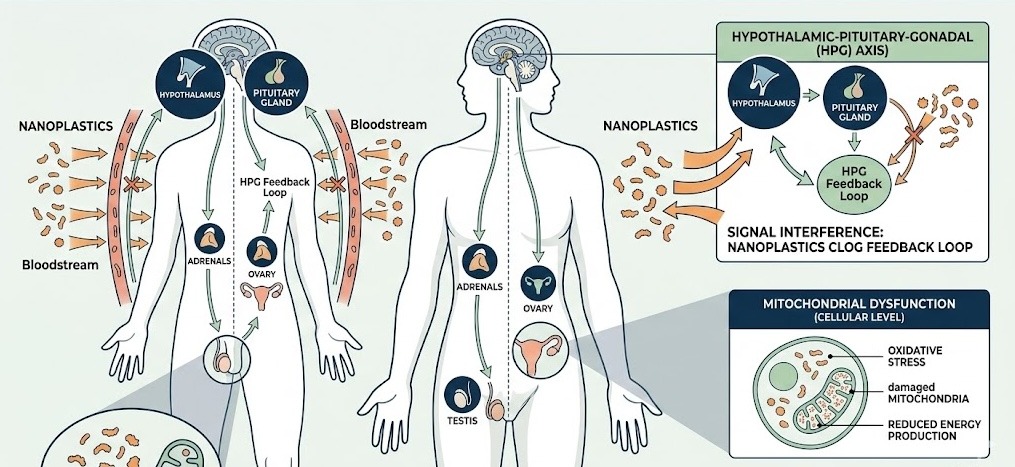
The Mechanism: Oxidative Stress and the HPG Axis
Microplastics don't just "sit" in these fluids; they interact with the cellular machinery. Because the particles from recycled fabrics are 20% smaller and more reactive [3], they are uniquely capable of:
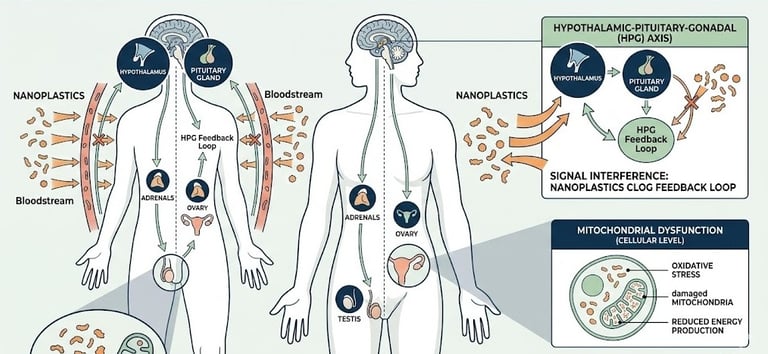
Mitochondrial Dysfunction: Once these nanoplastics penetrate a cell, they trigger oxidative stress, essentially "short-circuiting" the mitochondria. This is a primary driver of reduced sperm motility and poor egg quality.
HPG Axis Disruption: These particles act as physical and chemical disruptors to the Hypothalamic-Pituitary-Gonadal (HPG) axis. This is the thermostat for your hormones. When nanoplastics interfere with this feedback loop, we see the irregular cycles, low testosterone, and metabolic shifts that are becoming an epidemic in 2026.
The "Vetted" Audit: Beyond the Surface
When I "vet" a brand like MARO or look at untreated Merino wool, I’m not just looking for a soft feel. I’m looking for Biocompatibility. Natural protein fibers like wool or cellulose fibers like organic cotton are recognized by the body as biological matter. Synthetic polymers are recognized as foreign invaders. When you wear 100% synthetic activewear during a high-heat workout, you are consenting to a transdermal infusion of particles that your body simply wasn't designed to process.
The Takeaway
The "Hormone Audit" is clear: Human reproductive health is incompatible with the current mass-production of synthetic textiles. If you are trying to optimize your hormones—whether for fertility, mood, or athletic performance—you cannot ignore the 24/7 chemical interface of your clothing. It is time to move from "performance" fabrics to biological fabrics.
Technical Source List

[1] Abafe et al. (2024). "Assessment of Human Dermal Absorption of Flame Retardant Additives in Microplastics." Environment International.




[3] Gomez-Sanchez et al. (2025). "Detection and Characterisation of Microplastics in Human Follicular and Seminal Fluids." Presented at ESHRE 2025.
[2] Changing Markets Foundation (2025). "Spinning Greenwash: How Recycled Polyester Worsens Microplastic Pollution."


Contact
Reach out for questions or collaborations
© 2026. All rights reserved.