
The Greenwashing Gap
Why 'Recycled' Polyester is a Molecular Health Trap
Bill Morris
3/9/20263 min read
The Greenwashing Gap: Why 'Recycled' Polyester is a Molecular Health Trap
By William Michael Morris, Founder of Fabrics Vetted
In my 15 years as a materials scientist and biotechnology product leader, I’ve watched marketing departments turn incredibly complex problems into convenient, 15-second soundbites.
There is no better example of this than Recycled Polyester (rPET).
We are told a simple story: plastic water bottles are diverted from landfills, melted down, and turned into "sustainable" activewear. If you buy the rPET leggings, you are saving the planet.
But as a "Vetter," my job isn't to look at the marketing tagline. It is to look at the Molecular Integrity of the fiber. And from a molecular perspective, recycled polyester is an environmental and biological hazard. It is time to bridge the greenwashing gap.
The Material Science of rPET: Contamination and Brittle Fibers
When you create "virgin" polyester, you control the chemical stream from start to finish. When you create recycled polyester, you are dealing with a variable "chemical cocktail" of waste.
Plastic bottles carry over Bisphenol A (BPA) and other additives from their previous life cycle. While OEKO-TEX® updated their Standard 100 in 2025 to restrict BPA limits to 10 mg/kg [1], this only affects new certifications. Many legacy "recycled" products still on the market exceed this limit.
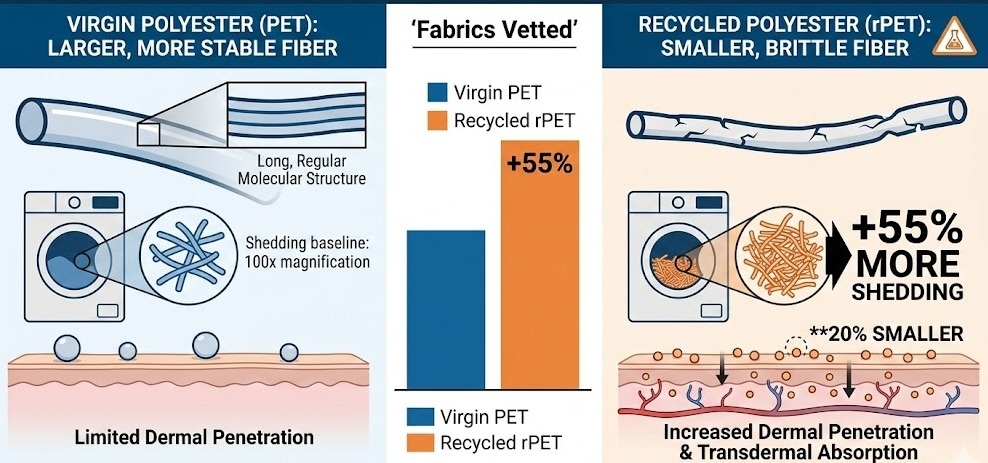
Worse, the high-heat process used to melt plastic degradation results in a fundamental loss of molecular integrity. This leads to two critical problems identified in a landmark December 2025 laboratory study by the Changing Markets Foundation [2]:
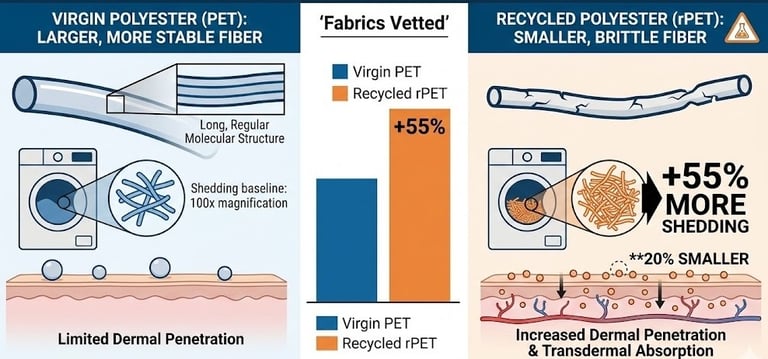
55% More Shedding: Lab testing of rPET garments confirmed they shed 55% more microplastics during a standard wash cycle than virgin polyester [2]. The recycled fibers are more brittle and break apart far more easily.
Smaller, More Bioavailable Particles: The microplastics shed from rPET were nearly 20% smaller than those from virgin poly [2].
Why 'Smaller' Means 'Toxic'
From a materials science standpoint, size is everything. Smaller particles have a higher surface area-to-volume ratio, making them far more reactive. In biological systems, these tiny microplastics become a "Trojan Horse."
Because they are 20% smaller, they are significantly better at:
Crossing Cell Membranes: Nanoplastics can pass through cellular walls and infiltrate tissues that virgin microplastics cannot.
Crossing the Blood-Brain Barrier (BBB): We are now seeing emerging data that these particles are small enough to pass into the central nervous system.
Infiltrating Reproductive Tissues: Microplastics (specifically PET and Nylon) have already been detected in human follicular fluid (eggs) and seminal plasma [3]. Smaller particles increase the rate of mitochondrial dysfunction and oxidative stress in these sensitive tissues.
The Vetted Audit: The Takeaway
Recycled polyester is a classic industry convenience solution. It solves a waste problem (bottles) by introducing a toxicity problem (wearable plastic micro-pollution). It is greenwashing at the molecular level.
For Fabrics Vetted, the score is clear: Recycled performance synthetics fail the audit for hormone safety.
Do not choose between the health of the planet and the health of your endocrine system. Choose neither. Demand 100% natural, untreated, biologically inert fibers.
Technical Source List
[1] OEKO-TEX® (2025). "New Regulations 2025: Stricter BPA & PFAS Limits."


[3] Gomez-Sanchez et al. (2025). "Detection and Characterisation of Microplastics in Human Follicular and Seminal Fluids." Presented at ESHRE 2025.
[2] Changing Markets Foundation (2025). "Spinning Greenwash: How Recycled Polyester Worsens Microplastic Pollution."
Contact
Reach out for questions or collaborations
© 2026. All rights reserved.