
"Made with Natural Materials"
How Fiber Blend Labeling Became Fashion's Most Effective Deception
Bill Morris
4/13/20266 min read
A garment can be 90% polyester and legally carry the claim "made with natural materials." No regulatory threshold prevents it. No labeling law requires disclosure of the dominant fiber in the marketing copy. The brand identifies the minority component, leads with it, and lets the consumer's imagination complete the sentence.
This is not a loophole. It is a strategy. And it is operating at scale across the apparel industry, from fast fashion to premium athleisure, exploiting a consumer population that has become educated enough to ask about fiber content but not yet equipped to decode what the answers actually mean.
The Architecture of the Claim
The mechanics are straightforward. A brand develops a garment that is, by fiber weight, predominantly polyester or nylon. To reduce cost, add stretch, or improve durability, the synthetic base is blended with a smaller proportion of a plant-derived fiber: viscose, Tencel, modal, bamboo, or organic cotton. The plant-derived component is real. Its presence on the label is accurate. What the label does not communicate is that the biological profile of the finished garment is determined by the dominant fiber, not the minority one.
A blend that is 10% viscose and 90% polyester will shed microplastics under heat and friction. The 10% viscose does not change that. A blend that is 15% organic cotton and 85% recycled polyester will release synthetic microfibers into the skin barrier during wear. The organic certification of the cotton does not extend to the polyester. The finished garment's chemical load is a function of what is predominantly present, not what is selectively highlighted.
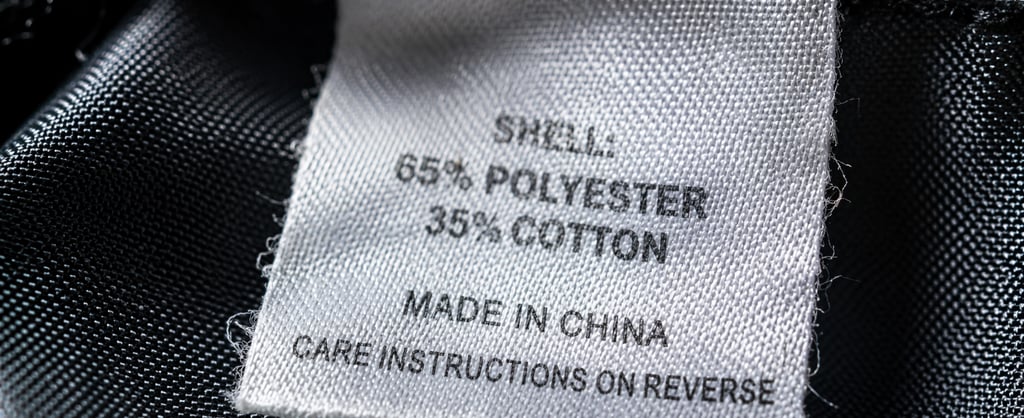
The US Federal Trade Commission's Care Labeling Rule requires that fiber content be disclosed as a percentage breakdown on the physical care label. It does not govern what claims appear on hangtags, marketing copy, or product description pages. The gap between those two documents is where the strategy lives.
The Viscose Problem
Viscose deserves particular attention because its origin story is so effective. It is derived from wood pulp, a renewable, plant-based raw material. It drapes like silk, absorbs moisture, and biodegrades under the right conditions. Brands deploy these facts readily. What they deploy less readily is the chemistry that converts wood pulp into a wearable fiber.
Conventional viscose production uses carbon disulfide, a volatile solvent, to dissolve cellulose into a spinnable solution. Carbon disulfide is not a benign processing aid. Associated health risks include coronary heart disease, psycho-physiological and central nervous system effects, with documented harm to workers in viscose manufacturing environments. Sustainfashion The occupational exposure literature on carbon disulfide spans decades. Studies of viscose rayon plant workers found neurological abnormalities, neuropsychological impairments, and cerebral atrophy among those with sustained exposure. PubMed
The consumer-facing question is not whether viscose workers face occupational exposure risks. They do, and that is a separate and serious issue. The consumer-facing question is what residual chemistry remains in the finished fiber after washing and processing, and whether that chemistry has dermal relevance during wear.
Trace amounts of carbon disulfide can remain in the finished fabric, especially when the production process is not highly regulated. The US Consumer Product Safety Commission and Health Canada do not currently require testing for carbon disulfide residue in textiles. The Cotton Lane In the absence of mandatory testing, the answer to how much residual chemistry reaches the consumer's skin is: unknown, and variable by manufacturer.
When viscose is blended with polyester, the finished garment carries two separate chemical exposure concerns operating simultaneously. Residual solvent chemistry from the viscose processing pipeline and microplastic shedding from the polyester component. The blend does not neutralize either. It compounds both. The brand's marketing copy addresses neither.
The Recycled Polyester Trap
The situation is compounded further when the synthetic component of the blend is marketed as recycled. Recycled polyester has become the fashion industry's flagship sustainability credential: plastic bottles converted into fiber, fewer virgin petrochemicals, a story of circularity that photographs well in a sustainability report.
The biology does not honor the narrative. Independent laboratory testing published in December 2025 found that recycled polyester releases more microfibres than virgin polyester, and releases finer particles. Changing Markets Finer particles have greater dermal penetration potential. The recycling process, which involves mechanical breakdown and re-extrusion of PET, produces a fiber with a more degraded surface structure than virgin polyester, increasing the rate of particle release under friction and heat.
When a brand blends recycled polyester with viscose and labels the resulting garment "sustainable," two distinct misdirections are operating. The natural fiber component is used to imply a clean biological profile the blend does not possess. The recycled descriptor implies reduced biological harm when the dermal exposure model is unchanged or worsened. The skin does not distinguish between virgin and recycled polyester microplastics. The endocrine system does not respond differently to particles derived from a plastic bottle versus particles derived from a virgin PET feedstock. The chemical structure is the same. The biological cost is the same.
The recycled framing is an environmental argument. It addresses what happens during manufacturing. It says nothing about what happens to the body during wear.
The Regulatory Gap
The labeling environment that enables this situation is not an oversight. It reflects the priorities of a regulatory framework built around consumer fraud in the traditional sense: is the product what it claims to be in terms of fiber composition? The FTC's Textile Fiber Products Identification Act governs accurate fiber content disclosure on physical labels. It does not govern the framing of that content in marketing communications. It does not require that a brand disclose which fiber dominates the garment's biological profile. It does not require disclosure of chemical processing history.
A "sustainable viscose blend" might legally contain only 10% certified fibers mixed with conventional materials. GreenWashing Index A garment marketed as "made with recycled materials" may derive that claim from a component that represents a fraction of the total fiber weight. The claim is technically accurate. The impression it creates in a health-conscious consumer is not.
The European Union has moved toward tighter regulation of environmental claims in apparel, but as of June 2025, the implementation of the Green Claims Directive is uncertain, with the European Commission signaling its intention to withdraw the proposal following political pressure. Carbonfact In the US, no equivalent initiative is in progress.
In the absence of regulatory intervention, the consumer is left to navigate a labeling environment designed by the industry being labeled.
What Accurate Reading Looks Like
The physical care label is a more reliable document than the hangtag or the product description page, but it requires interpretation the industry does not encourage.
Fiber content is listed by percentage in descending order. The first fiber listed is the dominant one. If polyester, nylon, elastane, or spandex appears anywhere in that list, the garment has a synthetic chemical profile regardless of what the marketing copy emphasizes. Percentage matters in ways that "made with" language deliberately obscures.
Cleaner alternatives to conventional viscose exist and are identifiable. TENCEL, the branded lyocell produced by Lenzing, uses a closed-loop solvent process that captures and reuses processing chemicals, with significantly lower residual chemistry in the finished fiber. Modal processed to OEKO-TEX Standard 100 is tested for harmful substance limits in the finished garment. These certifications are not required by law and cost money to obtain. Brands that carry them typically say so explicitly. If a label reads "viscose" without further qualification, conventional processing is the default assumption.
GOTS certification covers organic natural fibers through a restricted chemical processing standard. OEKO-TEX Standard 100 tests finished garments for a defined set of harmful substances. Neither certification permits the misleading blend framing described in this article. Neither is required by law.
The Biological Ledger
The TikTok conversation about natural fiber blends identified the right problem with incomplete framing. The issue is not only that synthetic content is concealed inside natural-sounding marketing claims. The issue is that the natural component itself frequently carries a chemical processing history the brand has no commercial incentive to discuss.
Both fibers in the blend have a story. The polyester component sheds microplastics with documented dermal absorption pathways and links to HPG axis disruption through oxidative stress. The viscose component, in conventional processing, carries residual chemistry from a neurotoxic solvent pipeline with no mandatory residue testing requirement in finished consumer textiles.
The blend marketing acknowledges neither. It leads with the minority fiber, the cleaner origin story, the plant-based credential, and allows the consumer to infer a biological safety the garment does not possess.
This is not accidental. The gap between what a label is required to say and what a brand chooses to say is not a failure of communication. It is the communication.
Fabrics Vetted examines the biological interface between apparel and the human body. FabricsVetted.com
References
US Federal Trade Commission. Textile Fiber Products Identification Act and Care Labeling Rule. FTC.gov.
Gelbke H-P, Goen T, Maurer M, Sulsky S. A review of health effects of carbon disulfide in viscose industry and a proposal for an occupational exposure limit. PubMed, 2009.
Kristensen P et al. Carbon disulfide exposure and neurotoxic sequelae among viscose rayon workers. PubMed, 1990.
Changing Markets Foundation. Spinning Greenwash: How the fashion industry's shift to recycled polyester is worsening microplastic pollution. December 2025.
Greenwashing Index. Is Viscose Sustainable? July 2025.
Harvard T.H. Chan School of Public Health. Carbon Disulfide Toxicity in Viscose Rayon Workers. 2020.
US Consumer Product Safety Commission. No current requirement for carbon disulfide residue testing in finished textiles.
European Commission. Green Claims Directive withdrawal signal. June 2025.
OEKO-TEX Association. OEKO-TEX Standard 100. oeko-tex.com.
Lenzing Group. TENCEL lyocell closed-loop production process. lenzing.com.
Contact
Reach out for questions or collaborations
© 2026. All rights reserved.