
The Gold Standard With a Blind Spot
What GOTS Does Not Tell You About Your Garment
Bill Morris
4/28/20264 min read
The Gold Standard With a Blind Spot: What GOTS Does Not Tell You About Your Garment
GOTS — the Global Organic Textile Standard — is the most rigorous textile certification available to consumers anywhere in the world. It covers the entire supply chain from farm to finished garment. It prohibits heavy metals, toxic dyes, PFAS, endocrine-disrupting compounds, and formaldehyde at every stage of processing. It requires third-party verification at every point in that chain. It operates across 89 countries and thousands of certified facilities.
It also permits recycled polyester.
That single permission — reasonable when the standard was written, increasingly difficult to defend in light of current science — is the blind spot worth examining.
What GOTS Gets Right
The case for GOTS as a meaningful consumer protection standard is substantive. The certification addresses a genuine problem: the conventional textile processing pipeline is saturated with harmful chemistry. Chlorine bleach, formaldehyde-based wrinkle resistance, azo dyes that cleave into carcinogenic compounds, PFAS-based water repellency treatments, heavy metal mordants — all of these are standard tools of conventional textile manufacturing. All of them are prohibited under GOTS.
The standard also governs what happens at the farm level. Organic fiber certification requires that the raw material was grown without synthetic pesticides or GMOs, under verified conditions with documented chain of custody. That farm-level integrity is carried through the entire processing chain under GOTS, not abandoned at the factory gate.
For a consumer navigating a labeling environment designed to obscure rather than clarify, GOTS is a genuinely useful signal. A garment carrying the full GOTS organic grade has been verified at every stage of its journey. That verification is worth something.
The 70% Rule
The standard has two label grades. The GOTS organic grade requires a minimum of 95% certified organic fiber content. The made with organic grade requires a minimum of 70%.
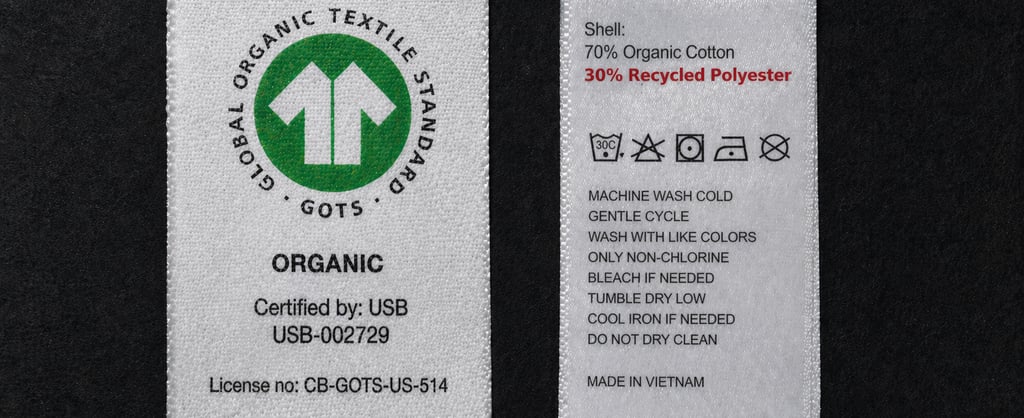
The distinction matters because most consumer-facing GOTS marketing does not make it. A brand that achieves the 70% threshold can carry GOTS certification and market its garments as GOTS certified without specifying which grade applies. The consumer who sees a GOTS label and infers a fully organic garment may be looking at a product that is 30% synthetic by fiber content.
That 30% synthetic allowance is not unlimited. GOTS restricts which synthetic fibers are permitted in certified garments. The list is short. The permitted option most relevant to activewear and everyday apparel is recycled polyester.
The Recycled Polyester Problem
The decision to permit recycled polyester as the compliant synthetic option was defensible at the time it was made. The environmental argument was coherent: recycled polyester diverts post-consumer plastic from landfill, reduces demand for virgin petroleum feedstock, and closes a material loop that conventional linear production ignores. For a standard designed around supply chain integrity and environmental responsibility, it was a logical inclusion.
The biological argument was not yet available. It is now.
Independent laboratory testing published in December 2025 by the Changing Markets Foundation found that recycled polyester releases more microfibers than virgin polyester during laundering, and releases finer particles. The recycling process — which involves mechanical breakdown and re-extrusion of PET — produces a fiber with a more degraded surface structure than virgin polyester, increasing the rate of particle release under friction and heat. Finer particles have greater dermal penetration potential. The particles cross the skin barrier more readily than larger fragments and reach systemic circulation at lower exposure thresholds.
The environmental framing of recycled polyester as a responsible material does not address this biological cost. The certification that permits it was not designed to. GOTS was built around supply chain chemistry and farming practices. Microplastic shedding behavior during consumer wear was not part of the original risk model.
The risk model has changed. The certification has not.
What This Means at the Garment Level
A garment carrying GOTS certification at the made with organic grade can contain up to 30% recycled polyester under a fully compliant standard. The organic fiber component has been grown without synthetic pesticides, processed without prohibited chemistry, and verified at every stage of the supply chain. That component is clean by any reasonable standard.
The recycled polyester component has not been evaluated for microplastic shedding behavior under the certification. It is present in the garment with the implicit endorsement of the standard's overall credibility, despite the fact that its biological profile during wear is now documented as more problematic than the virgin synthetic alternative it was chosen to replace.
The consumer who purchases a GOTS certified garment expecting comprehensive biological safety has received something more limited: assurance about the organic fiber's agricultural and processing integrity, and silence on the synthetic fiber's behavior against skin.
The Certification Gap
This is not a criticism of GOTS as an institution. The standard represents genuine and ongoing effort to bring transparency and accountability to a supply chain that resists both. The breadth of what it prohibits is substantial. The verification infrastructure it has built is real.
The gap is specific: a synthetic fiber permitted by the standard on environmental grounds has since been found to carry a biological cost that was not part of the original evaluation. The evidence now exists. The standard update has not followed.
GOTS reviews and updates its standards periodically. The microplastic shedding data for recycled polyester is now peer-reviewed, independently verified, and publicly available. The case for revisiting the recycled polyester permission is not speculative. It is a straightforward application of current evidence to an existing standard.
Until that update occurs, the consumer navigating GOTS-certified garments needs two pieces of information the label does not automatically provide together: the certification grade — organic at 95% or made with organic at 70% — and the full fiber content breakdown from the care label. If recycled polyester appears in that breakdown alongside a GOTS certification, the garment has met a rigorous standard on its organic component and a standard written before current evidence on its synthetic one.
That is not a reason to dismiss the certification. It is a reason to read the whole label.
Fabrics Vetted examines the biological interface between apparel and the human body. FabricsVetted.com
References
Global Organic Textile Standard. GOTS Version 7.0. global-standard.org.
GOTS label grades: 95% minimum for organic, 70% minimum for made with organic. theroundup.org, 2026.
Changing Markets Foundation. Spinning Greenwash: How the fashion industry's shift to recycled polyester is worsening microplastic pollution. December 2025.
GOTS permitted fiber inputs including recycled polyester. global-standard.org.
OEKO-TEX Association. OEKO-TEX Standard 100. oeko-tex.com.
US Federal Trade Commission. Textile Fiber Products Identification Act. ftc.gov.
Microplastic particle size and dermal penetration. Peer-reviewed toxicology literature.
GOTS prohibited substances list: heavy metals, PFAS, azo dyes, formaldehyde, endocrine disruptors. global-standard.org.
Contact
Reach out for questions or collaborations
© 2026. All rights reserved.